
My Blue Could be Your Green
My Blue Could Be Your Green
After efficiency and novelty, real creativity will drive the next great renaissance of the mall
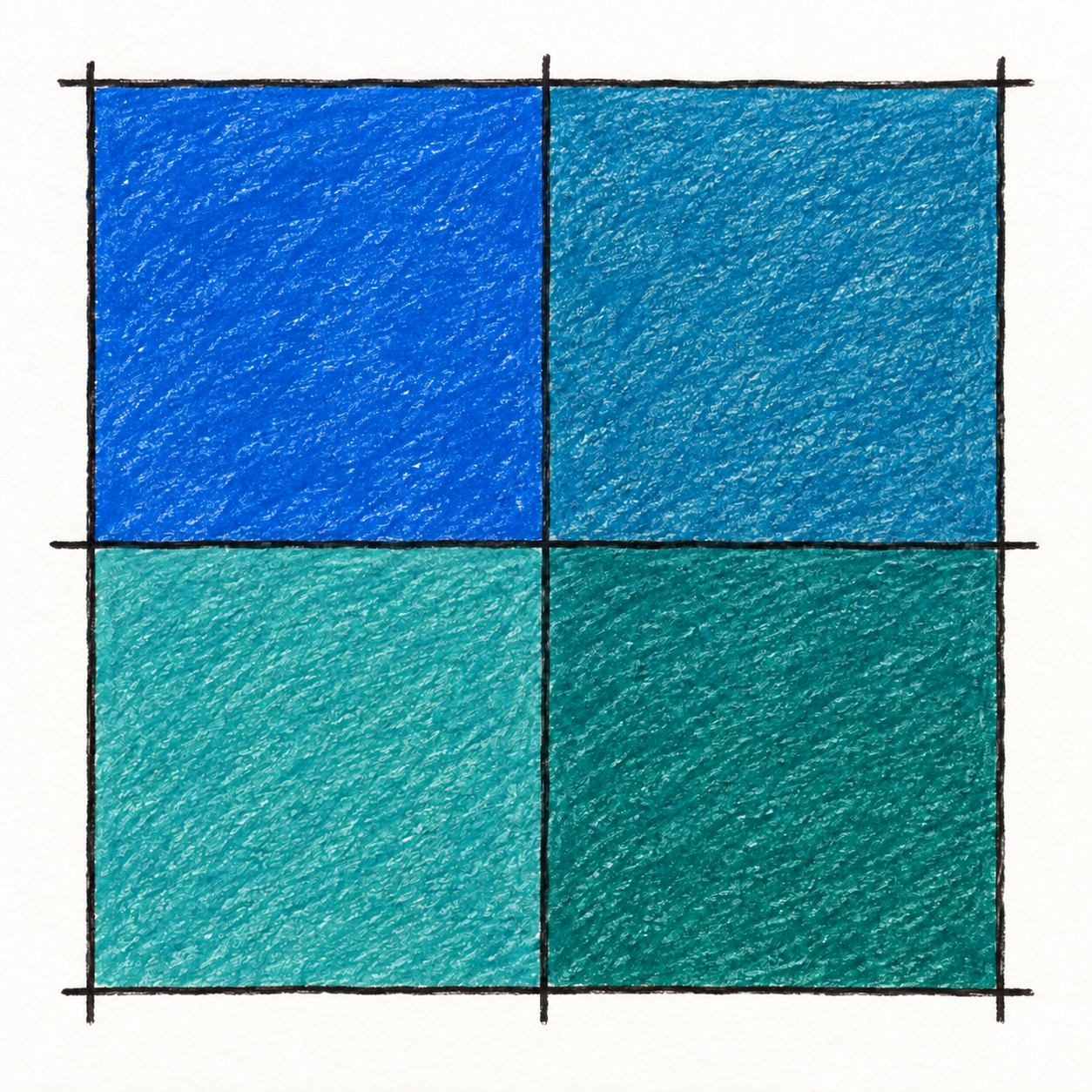
The image was laid out in pencil to scale by the author. The outlines of the squares were inked by hand with a fine-point Sharpie on Astrobrights paper. The squares were hand colored with Prismacolor pencils. The art was uploaded to an AI program with detailed instructions to facilitate replication for this article.
BY J. RICHARD HILL
Years ago, I was lying in a wooden dugout canoe on the shore of M’fangano Island on Lake Victoria, near the Ugandan border, with Naftaly, an elder of the Suba people. This was my third trip to Kenya and the island to assist a missionary group in forming an economic development strategy focused on tourism. This trip was just with my daughter Devon, who later became a cultural anthropologist, and it gave us more one-on-one time with Naftaly, a man of great wisdom, who taught us about what community meant to this small remote island, which was an hour’s motorboat ride from the Kenyan mainland, resulting in a transportation cost to the mainland far beyond the means of most of its inhabitants.
It was a clear blue-sky kind of morning, no breeze, neither warm nor cool, and the lake was smooth as glass. While Devon was paddling in a leaking dinghy with two Suba boys, one bailing water and the other just for the ride, Naftaly pointed upward and asked:
“What color do you see, brother Rick?”
“Blue,” I said.
I asked him, “What do you see?” He responded, “Blue.”
I pondered his question, and one question led us to another.
Both of us labeled the color of the sky as blue, but neither of us could prove we saw the same actual color. My blue could be his green.
Likewise, two people can look at the same image or hear the same words and each assume the other understood it the same way. In real estate we write descriptions, use data sets, and present drawings, illustrations, and diagrams to communicate the essence and facts of a tangible asset. One person interprets the information as a bad risk, another as a great idea for economic development, and one sees himself with a silver shovel at groundbreaking, while another thinks “not in my back yard.”
“Both of us labeled the color of the sky as blue, but neither of us could prove we saw the same actual color. My blue could be his green.”
Monet and the Rendering
I believe that great works of art express human emotions and generate emotional responses better than any other form of communication, because they evoke emotions that words cannot easily express.
Artists seldom use mathematical patterns for the creation of art that comes from their heart and soul. Sure, there are exceptions, such as Roy Lichtenstein’s comic book art, and especially in how original works of art are replicated through the mechanical process of printmaking, but there is a real difference between a handcrafted paint-by-number-like image and an unstructured masterpiece by an impressionist. Ironically, Lichtenstein’s work blurred the lines between fine art and consumer culture. As I write this, the Whitney Museum has just opened Roy Lichtenstein: Like New, an exhibition about how his images were duplicated, scaled up, and recirculated, on view through May 10, 2027.
When Claude Monet painted his Water Lilies, he did not attempt to create a literal reproduction of green lilies on a blue pond. He created an emotive work of art on canvas, one color stroke at a time, often placing disconnected colors side by side and then blurring the division of color to move beyond a hardlined representation to an atmosphere of light, haze, and reflection. Monet’s process was one of spontaneous discoveries that did not follow a set pattern or instructions.
Computer-generated images in commercial real estate often do the opposite. Software creates an image of certainty by mechanically arranging colored pixels in a predetermined matrix to produce a photorealistic view of a place.
An AI illustration is created by software that statistically arranges pixels with the highest probability of matching a prompt. Yet viewers of AI images can detect the digital sleight of hand, shifting their initial impression to an unintended direction. When a rendering is so specific that it leaves little room for personal interpretation, the mind consciously or subconsciously rejects it as artificial.
When a land planner’s master plan, designed to highlight the flowers in a garden in the first light of a summer morning, or an architect’s design of a mountain resort’s wedding chapel, created to reflect in a pond at sunset, gets muted or marginalized by unneeded clutter, we lose the essence of what the designer wanted us to feel and experience about the place.
To a professional making money from real estate transactions, the value of how one feels about a place is only measured by how much more they will pay for that feeling.
“When a rendering is so specific that it leaves little room for personal interpretation, the mind consciously or subconsciously rejects it as artificial.”
When someone writes about commercial developments, I want to learn from their real experiences. I want to hear their voice in their own written words. But many posts on social media designed for professional knowledge sharing are clearly AI-generated. They appear to have originated with a good idea but were advanced with AI thought and quickly disseminated in a format designed to be read by algorithms to increase clicks. Maybe it is just me, but as soon as I recognize the telltale signs of a computer-generated post, I discredit what may have started as a worthwhile message.
I want to know what the writer thinks, and I want to learn from their lived stories and the knowledge that comes from real experiences. Conversely, the well-primed machine does not have actual experiences to share. Its words are statistically assembled as the most probable words to follow the previous words. When this occurs, the reader realizes the narrative is machine-generated, and it creates a crisis of trust. Once the personal perspective leaves the written post, I think most readers disassociate and move to a point of disengagement and to superficial scanning, at best.
The Rush to Efficiency
My critique of quick-to-market computer imagery is my canary-in-a-coal-mine warning of the implications of the loss of human expression along with the creative innovations required to re-imagine the physical marketplace beyond a place primarily engineered for the transaction of goods and services.
Technology enables the removal of barriers, conflicts, and time delays in the acquisition of goods, and it will continue to do so. The merchants, developers, and capital markets demand cheaper, faster, and lower cost, but perhaps unknowingly at another cost, which is the loss of all that makes the physical marketplace a place people enjoy visiting and staying.
In 1983, I spoke at a Value Retail News conference in Atlanta and stated that commodity goods would ultimately find their most efficient means of distribution to the end consumer, and that was long before the internet, Amazon, and same-day delivery. This rush to efficiency has largely contributed to the rejection of the enclosed public promenade, center court plazas and fountains, and even large-screen cinema projections in 400-seat theaters.
But research proves that value in real estate is also created when people establish a personal relationship with a physical place beyond its pure functional utility. When great places are human-centered with memorable public spaces, and places that enchant, people will freely spend their most precious commodity in that place, which is their time.
As improvements in digital logistics continue to make the acquisition of goods increasingly efficient, retail distribution channels will continue to fragment but within two primary models. One side will be organized around selection, speed of distribution, and price. The opposite side is a physical, experiential marketplace that offers more than a product for a price. It is here that meaning, connection, experiences, gathering, and community will be the attributes that create a place of value that is beyond the ability of technology to rapidly replicate.
“When great places are human-centered with memorable public spaces, and places that enchant, people will freely spend their most precious commodity in that place, which is their time.”
But this raises the question: what should the experiential marketplace look and feel like, and how should it be merchandised in a larger world driven by technology?
Today, there are many examples of efforts to backfill malls with various forms of entertainment. JLL recently reported tracking 207 entertainment concepts operating in more than 4,700 locations in the U.S. and Canada, with another 721 planned. Yet, I believe roller coasters, escape rooms, virtual reality arcades, and interactive and immersive dining experiences will not be the foundation of a reinvented and sustainable enclosed mall.
The notion of adding entertainment to malls is not new. Developers have been trying to add and sustain novel forms of entertainment in malls and entertainment districts for over thirty years. Jillian’s, GameWorks, DisneyQuest, ESPN Zone, Punch Bowl Social, Pinstripes, Virgin Megastore, and many more have all failed. The new technology and novelty generate initial interest, but each attraction is soon replaced by newer, more advanced concepts or fails to generate sufficient return visits after the novelty wears off to sustain the business model.
Gruen, Rouse, and the Original Mall
The modern era of enclosed shopping malls did not begin as investments into a new asset class; they began as social experiments. People have always sought places to gather, to be part of a community, spend time with friends and loved ones, or to just be in a place that is captivating, enlightening, and relaxing. To a great degree this was the vision of Victor Gruen, the originator of the enclosed American mall. His original concept of a pedestrian-only, climate-controlled enclosed mall was first executed with the opening of Southdale Mall in Edina, MN, on October 8, 1956.
Gruen’s principles were refined in 1961 through his collaboration with developer James Rouse on Cherry Hill Mall in Delaware Township, New Jersey. There, Southdale’s functional, utilitarian prototype evolved into a more human-centered indoor landscape featuring sunlit tropical gardens, aviaries, reflecting pools, sculpted seating, large Alexander Calder-like hanging mobiles, and active programming in public areas.
Cherry Hill Mall was initially anchored by Strawbridge & Clothier, and one year later Bamberger’s opened to create a dual-anchor dumbbell with a single-level pedestrian promenade, yet one filled with human-enriching places. In doing so, Rouse demonstrated that the enclosed mall could be the social, cultural, and the shopping heart of suburbia.
While Southdale was an execution of Gruen’s architectural theory, Rouse created a definitive and repeatable template of the American mall as the center of suburban life. Within weeks of the mall’s October 1961 opening, Delaware Township voted to change its name to Cherry Hill.
Rouse replicated the Cherry Hill design in August of 1962 with the Mall in St. Matthews, Kentucky, a Louisville suburb. A month after opening, my parents took me to the Mall on my 10th birthday, and I was amazed by the variety of stores, but it was the areas between the stores with tropical gardens, volcanic rock, the aviaries, reflecting pools and fountains, a life-sized chess board, kiosks, and sidewalk artists that captured my imagination. A little less than ten years later, I entered the mall industry as a promotions and special events director of the Mall.
I recall a talk given by Jerry McDermitt, the Senior VP and Director of Rouse’s Operating Mall Division, where he essentially stated that if we created and operated great malls first for our communities, the profits would come as a by-product.
Jim Rouse and Walt Disney
As The Rouse Company began to replicate and expand its mall concept across Pennsylvania, through New Jersey, and into Texas, Jim Rouse, an absolute visionary, began to focus on his grandest humanitarian experiment: building a complete and integrated city that balanced social equity and financial profits with the development of the 14,000-acre master-planned new city of Columbia, Maryland. At this same general time, Walt Disney was working with economist Harrison “Buzz” Price on the conceptualization and financial feasibility of his own urban experiment: EPCOT (Experimental Prototype Community of Tomorrow). Rouse and Disney were not personal friends but were united by a shared vision of a better place to live. Both envisioned full and complete cities. Disney spoke of technology, industry, and the happiness of its community, while Rouse spoke of creating a garden for growing better people as an antidote to suburban sprawl and urban decay.
In 1963 Rouse addressed the Harvard Graduate School of Design, delivering a statement that surprised the architectural establishment:
“I hold a view that may be somewhat shocking to an audience as sophisticated as this: that the greatest piece of urban design in the United States today is Disneyland.”
Rouse openly praised Disney for achieving what conventional planners had failed to deliver: a clean, safe, joyful, and pedestrian-friendly public community.
When Walt Disney stood before cameras in October 1966 to film the presentation introducing EPCOT to Florida officials and the press, the film opened by quoting Rouse’s Harvard speech.
But in the following decades the vision of Gruen, Rouse, and Disney was challenged by changing consumers, construction costs, technology, and the unforgiving capital market.
The public markets demanded short-term returns, and the fountains, trees, and other amenities were stripped out to reduce common-area expenses and make room for kiosks to sell trinkets even if they devalued the mall experience.
Filling the Void
The marketplace has rewarded shopping centers that became the most efficient places to obtain a product for a price when that was their only goal. But that has led to contractions, vacancies, and underutilized real estate, and most of all, a loss of places that offer more than a product for a price.
The computer has facilitated the speed of transactions, but it cannot see, feel, or know. It cannot share a story because it has never lived one. Perhaps most importantly, technology alone cannot create memorable places that attract people on a recurring basis.
The more synthetic imagery and automated text flood our screens, and the more efficient and isolated our basic consumption becomes, the more people will seek evidence of human creativity in the images we see, the stories we read, the lives we live, and the places we visit.
“The computer offers speed and polish, but it cannot see, feel, or know. It cannot share a story because it has never lived one.”
In the future the built world will embrace places that restore community in the marketplace. These will be majestic places, rich in materiality, and designed around natural landscaped environments. They will be places of wonder and canvases of human expression and creativity and full of people enjoying life.
Today, the trend is to monetize the experiential marketplace within pay-to-play tenant-operated spaces, while minimizing public areas.
In my future world, technology will float into the background while pay-to-play and pay-to-dine immersive and experiential concepts operate in black boxes designed for flexibility and change. The public common areas and gathering places will be the most sustainable experience as they will return to natural environments of subtle sounds, music, art, grass, trees, flowers, waterways, fountains, lanterns, mist, fog, clouds, sunlight, starlight, and moonlight, all carefully orchestrated to nourish the heart.
Tivoli Gardens in Copenhagen, Denmark, is the world-famous themed public garden that served as one of Walt Disney’s primary inspirations for Disneyland. I have visited Tivoli. Its trees, dancing waters, lantern-like lighting in its tree canopy, sparkling Tivoli strands of lights, lush gardens, and people sitting and enjoying a summer night are part of my own inspiration for the great mall of the future.
The mall of Victor Gruen and James Rouse will return with a grand renaissance of their guiding principles about public space, public gardens, community, and social engagement in formats that create extraordinary destinations along with varied combinations of shops, residential, hotels, cultural centers, and sporting venues. This will require new forms of partnerships between cities, developers, merchants, sporting teams, and nonprofit cultural centers.
Postscript
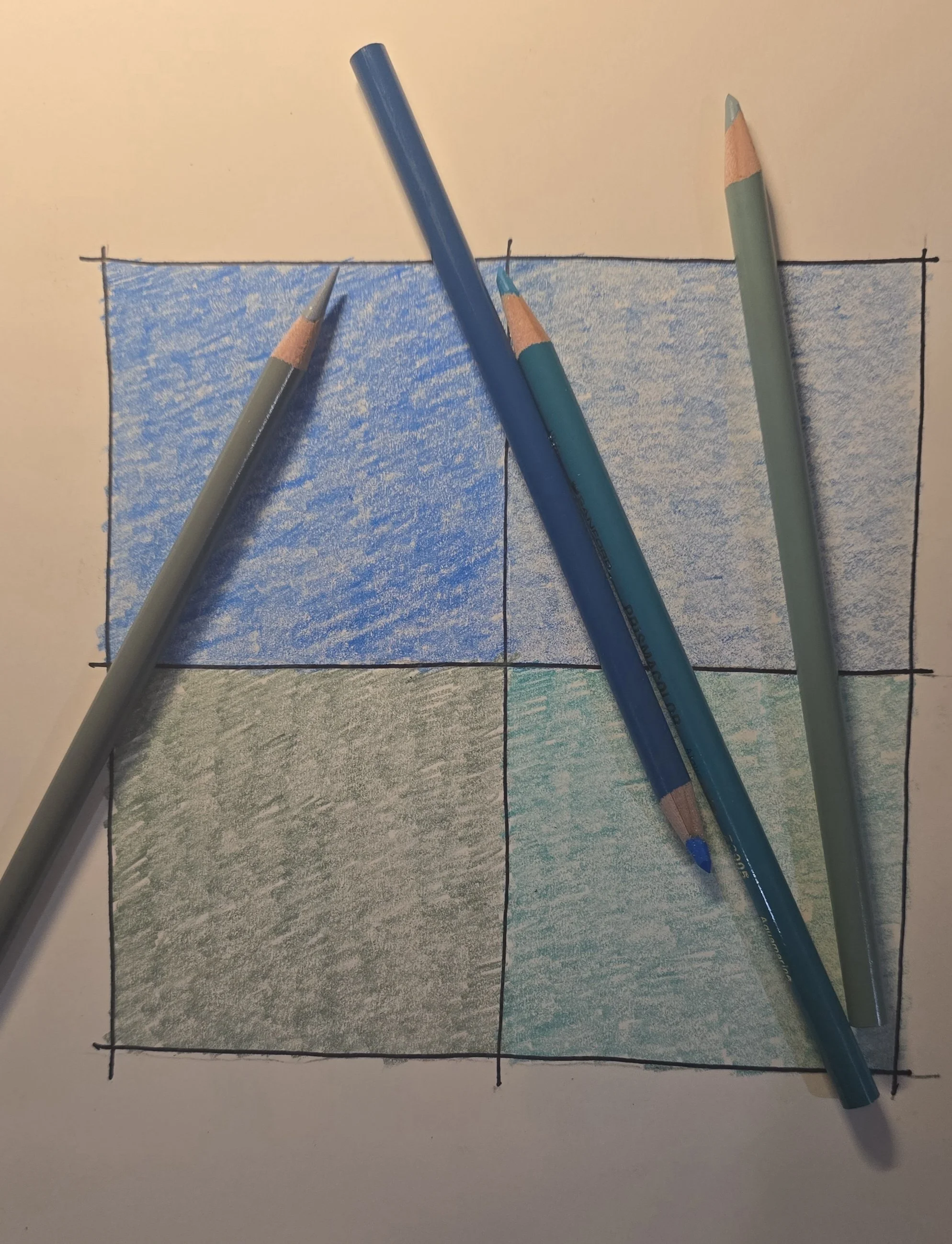
As noted under the image that runs with this article, I used an AI-generated image, which on the surface may contradict the entire thesis. To be clear, I use AI as a tool. Below is an image of my original drawing, which I drew by hand. When it was scanned, the colors were muted and the pencil strokes were more pronounced than in the actual work. To correct the problem, I uploaded the scan of the actual work to an AI program where I could better smooth out the lines and coordinate the colors to convey my true intent.
ABOUT THE AUTHOR
J. Richard (Rick) Hill is a real estate strategist specializing in the planning, positioning, and redevelopment of marketplaces, mixed-use developments, resorts, destination communities, historic districts, attractions, and projects in culturally significant places. During a career spanning more than fifty years and over two hundred consulting assignments throughout the United States, the Kingdom of Saudi Arabia, the United Arab Emirates, China, and Mexico, he has advised institutional investors, developers, hospitality companies, municipalities, and international clients, including the National Park Service, the 1996 Atlanta Olympic Games, the historic Coney Island theme park, Nike, and Four Seasons and Ritz-Carlton resorts.
He began his career in 1976 at The Rouse Company’s Mall in St. Matthews, first used the term lifestyle center in print in 1982, and is a three-time ICSC Maxi Award winner and the recipient of a ULI award for Best Redevelopment of an Outdoor Center.
